
One of the biggest lessons I learned during this remodel had nothing to do with tile, paint colors, or finishes.
It had to do with placement.
Specifically, where plumbing comes out of the wall.
Because once plumbing is roughed in, everything else has to work around it.
And that is a much bigger deal than most people realize.
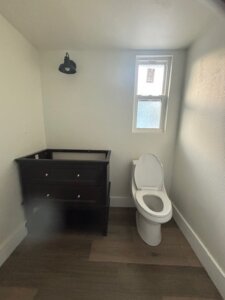
This vanity required interior drawer modifications and a cabinet notch to work around the existing plumbing placement.
Why Vanity Placement Matters in a Bathroom Remodel
When people think about remodeling a bathroom, they usually start with style. The vanity design, the countertop, the mirror, the lighting. All the fun parts.
But what actually determines whether your vanity works is something most homeowners do not think about until it is too late.
The plumbing rough in placement.
Your vanity has to fit the plumbing location, not the other way around.
The Common Remodel Mistake
A typical remodel timeline often looks like this.
First, plumbing is roughed in.
Then walls are closed.
Finishes begin.
The vanity arrives.
And that is when you realize the vanity does not fit the plumbing.
Not because anyone did bad work. Not because someone was careless.
But because the vanity specs were not finalized ahead of time.
What Happens When the Vanity Does Not Line Up
When plumbing placement and vanity layout do not match, you are left with workarounds.
You might have to cut a notch in the back of the vanity cabinet.
Modify interior drawers.
Remove a section of storage.
Shift shelving.
Or accept that the vanity has to sit exactly where the plumbing is.
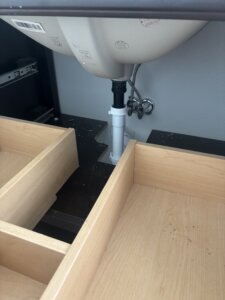
This vanity required interior drawer modifications and a cabinet notch to work around the existing plumbing placement.
These solutions can absolutely work.
But they are fixes, not plans.
And fixes almost always cost more time, more effort, and sometimes more money than thoughtful planning would have.
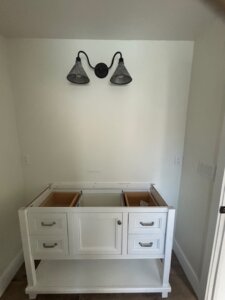
Even vanities that look similar on the outside can have completely different interior layouts.
Why Vanity Specs Should Be Chosen Before Plumbing Rough In
Every vanity is built differently. Drawer configurations vary. Cabinet openings are different. Sink placement shifts. Interior framing changes. Even depth and height can impact how plumbing fits inside.
Two vanities that look identical from the outside can have completely different interiors.
Before plumbing rough in, you should know the vanity width, sink placement, drain location, and how much clearance exists inside the cabinet.
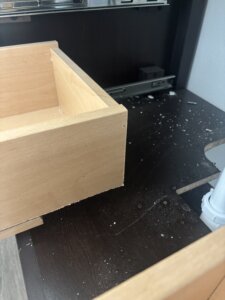
Even vanities that look similar on the outside can have completely different interior layouts.
You do not necessarily have to purchase the vanity yet.
But you absolutely need the spec sheet.
This Lesson Is Bigger Than Just Vanities
What this remodel really taught me is that this is not just about bathrooms.
It is about a larger remodeling principle.
Anything that goes inside a wall should be planned before the wall closes.
That includes plumbing, electrical, outlet placement, lighting locations, HVAC lines, mini splits, appliance hookups, and even pest prevention treatments on framing.
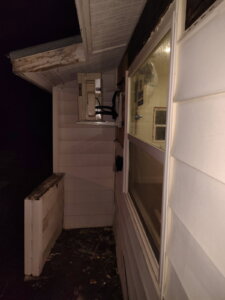
Systems like mini splits must also be planned before walls close. Once installed, placement is far harder to adjust.
If you are at the framing stage, it is worth considering treating the wood for termites and pests before drywall goes up. Once the walls are closed, that opportunity is gone.
Drywall does not just close a wall.
It locks decisions in place.
The Difference Between Rushing and Planning
Something I have noticed while working with different trades is this.
Fast decisions feel productive.
Thoughtful decisions prevent problems.
You can always tell when someone is thinking ahead. They are not just focused on their step. They are thinking about what comes next.
That mindset is what keeps a remodel running smoothly.
The Real Life Takeaway
If you remember one thing from this lesson, let it be this.
Pick your fixtures before your rough ins.
At the very least, know the exact specs before the walls close.
Moving a vanity is easy. Moving plumbing is not.
And if you are reading this thinking that this is exactly what happened to you, do not panic.
Notch what you need. Modify what you have to. Adjust and move forward.
It will still look beautiful. And most of the time, you will be the only one who knows what had to happen behind the scenes to make it work.
Remodeling is never perfectly linear. It is learning in real time. And that is part of the process.
Next Chapter: Appliance Placement and Layout Lessons
In Part 5 of the Remodel Diaries, we are talking about appliance placement and how layout affects flow and function. Plus the ideas I wish I had thought of earlier before everything was locked in.
Love What You Read? Check Out Parts 1-3 Here!
The Remodel Diaries (Part 1): Why Framing Is the Skeleton of Your Home
The Remodel Diaries (Part 2): Openings, Measuring, and Planning for the “Skin” (Drywall)
The Remodel Diaries (Part 3): Trial, Error, and Drywall Dust