
If framing is the skeleton of the house, then the openings are the joints and structure points that everything depends on.
I learned this quickly during this remodel.
It’s not enough for a wall to exist. It has to be measured correctly for what’s going inside it.
Because once you start adding drywall, trim, doors, and finishes, the space changes.
What feels fine during framing can suddenly feel tight, off, or unfinished once everything is installed.
In this chapter, I’m talking about openings, including doors, windows, and closets, why measuring matters so much, and how planning ahead saves time, money, and frustration.
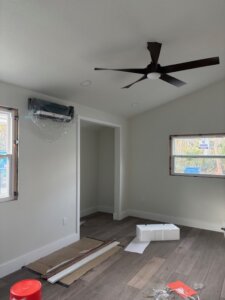
This closet was intentionally left without doors. During framing, I missed the opening dimensions needed to comfortably add doors later. Instead of forcing something that wouldn’t feel right, I chose to leave it open. It’s a reminder that opening measurements directly shape your final design choices.
What “Openings” Mean in Remodeling (And Why They Matter)
In a remodel, openings include doorways, windows, closet openings, pass-throughs, niches, and any framed space that needs to fit something later.
These areas often look simple on paper, but they’re some of the easiest places to make mistakes.
That’s because you’re not just framing a wall.
You’re framing something that has to fit perfectly once finishes are added.
Measuring Matters More Than People Think
Here’s the truth. A half inch here and there becomes a real problem once finishing begins.
If openings aren’t framed correctly, you can run into issues like doors that don’t sit right, trim gaps you can’t unsee, uneven reveals around frames, closets that feel tight or off-centered, and windows that don’t finish cleanly.
And once drywall goes up, those problems are much harder to correct.
This is one of those moments where slowing down early saves you from fixing things later.
Remember This: The Skeleton Gets Dressed
This is one of the biggest lessons I want homeowners and investors to understand.
Framing is the skeleton. Drywall is the skin. And that skin takes up space.
So when you’re measuring an opening, you’re not measuring it for how it looks right now.
You’re measuring it for what it will become once it’s finished.
That includes drywall thickness, corner bead, mudding, trim, and flooring transitions.
Planning for those layers ahead of time makes everything else fit the way it should.
Closet Openings Are Easy to Miss (But They Matter)
Closets don’t always get the attention they deserve during the rough framing stage.
But once you start installing closet doors, shelving systems, and trim packages, it becomes clear very quickly that closet openings need just as much precision as any other part of the home.
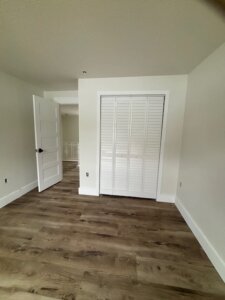
In this room, the closet doors had to be trimmed along the edges because the opening was off by about half of an inch. It’s a small adjustment, but one that could have been avoided with tighter measurements during framing.
Closets are one of those areas where “good enough” feels fine at first, until the finish work shows that it isn’t.
Planning for What Goes in the Wall (Before Drywall)
This part connects directly to framing and layout.
When you’re planning openings, it helps to ask a few simple questions.
What’s going on this wall. What needs to be mounted here. What needs support. What needs clearance.
Because it’s not just about the opening itself. It’s about how the space will function once the home is being lived in.
Older Homes: Expect Imperfections, Plan for Adjustments
If you’re working on an older home, especially one that’s 50 to 100 years old, you’re going to run into uneven framing, shifted walls, non-standard openings, and floors that aren’t perfectly level.
That doesn’t mean the remodel is doomed.
It means you need someone who can read the structure, understand what they’re seeing, and know how to adjust.
That’s where experience really shows up.
Next Chapter: Drywall Is the “Make or Break” Moment
In Part 3, we’ll talk about drywall installation.
Because once drywall goes up, you start to see whether the framing and openings were planned correctly.
And yes, mudding helps. It can fix small imperfections and even some bigger ones.
But it’s still an extra step that has to be done right.
You don’t want the plan to be, “We’ll just mud it later.”
April 16th, 2026
The Remodel Diaries (Part 5): Appliance Placement, Flow, Function and Lessons Learned
Appliances are not just selections, they are…